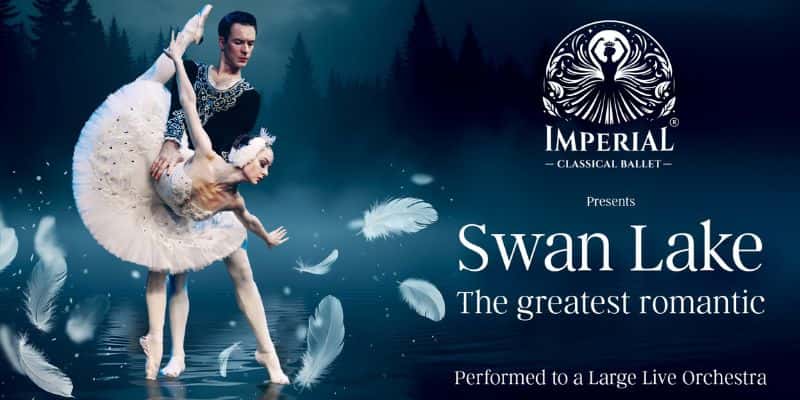
If you have never seen Swan Lake in the flesh, a one-off performance at York Barbican on Monday 19 October at 7.30pm is a decent place to start. The Imperial Classical Ballet brings the production to Paragon Street for a single evening, and the big draw here is that Tchaikovsky's score is performed by a full live orchestra rather than a recording, which changes the whole feel of the room.
Every week we pick 🏆 the 5 best 🏆 things to do in York and send them to your inbox. Just one weekly email, no spam.
By submitting your email, you accept our Privacy Policy
The story is the one everyone knows: Princess Odette is cursed to live as a swan by day and a woman by night, and Prince Siegfried's vow of love is the only thing that can break it, while the sorcerer Rothbart and his daughter Odile work a deception in between. For anyone who has seen it before, the Black Swan pas de deux is still the moment to look forward to, but the production is built to be clear enough that it works just as well as a first experience. It pulls together international dancers, classical choreography, costumes and scenery, all carried by the live orchestra.
Behind the scenes, the production comes from Amande Concerts, a company that has made regional touring the centre of its work. This stop is part of the Imperial Classical Ballet's UK tour, which marks twenty years of the company taking classical work to audiences across the country. Over the last decade alone, they have run more than thirty tours with international artists across ballet, opera and folklore, playing more than 1,250 times at over 100 regional theatres, with half a million people through the doors. This 2026 season is the anniversary lap on that record.
A bit of background helps set the scene. Tchaikovsky wrote Swan Lake between 1875 and 1876, originally calling it 'Lake of Swans', and based it on Russian and German folk tales about a hunter or woodcutter who meets a swan maiden. The original librettists were Vladimir Begichev and Vasily Geltser, and the Bolshoi Ballet premiered it in Moscow in March 1877. The version most companies stage today, however, is the 1895 revision by Marius Petipa and Lev Ivanov, with the score reworked by Riccardo Drigo, which first appeared at the Mariinsky Theatre in St Petersburg. Tchaikovsky himself was born in Votkinsk in 1840, started piano at five, studied law before enrolling in Anton Rubinstein's new music college in 1863, and worked as a civil servant before becoming a professor of harmony in Moscow in 1866. He was paid 800 rubles for the score, which he finished in a year and wrote for a late-19th-century orchestra of strings, woodwind, brass and percussion.
Tickets can be booked through the York Barbican box office, online at amande-concerts.co.uk/whats-on/ or via Ticketmaster, with a booking fee on top, and there are exclusive hospitality options if you want to make an evening of it. Under-14s need to be accompanied by an adult aged 18 or over. Because it is a one-night-only visit, there is no second chance if you miss it, so it is worth sorting tickets rather than leaving it to the day.
Published Date
8 October 2026