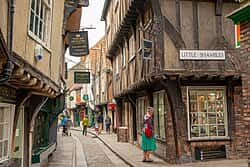
The Shambles is only about 400 feet (120 metres) long, but it packs a lot into that short walk. Running between Newgate and Pavement in central York, the pedestrianised street is lined with timber-framed buildings whose upper floors lean out over the pavement. Many date from around 1350–1475, and the uneven rooflines and narrow passageways give the street its familiar medieval character. It is also one of York’s busiest photography spots, so an early visit or a late-afternoon wander usually gives you more room to look up at the buildings rather than simply follow the crowd.
Every week we pick 🏆 the 5 best 🏆 things to do in York and send them to your inbox. Just one weekly email, no spam.
By submitting your email, you accept our Privacy Policy
The street’s past was practical rather than picturesque. It was once known as the Great Flesh Shambles, and butchers sold meat from open-fronted shops. Wooden shelves still survive outside some properties, recalling the old shop fittings. The name comes from an Old English word for a bench or stall. In 1885, 31 butchers’ shops were recorded here; the last disappeared in the early twentieth century. Five small snickelways lead off The Shambles towards the wider Shambles Market, where the former rear plots were opened up after changes made in the 1950s. The market, at 5 Silver Street, now has more than 75 independent stalls and is open daily from 9am to 5pm, with free entry.
For photographs, try the entrance from Stonegate, then walk towards the top of the street and turn back for the full view of the overhanging façades. The side alleys offer a closer look at the timber frames, while the shopfronts provide plenty of small details. Today’s businesses range from British Wool and Cashmere, Ipsofacto Art and Hebden Tea to chocolate, sweets, gifts and clothing shops. There are also places to pause, including Parlormade Café and Scone House, Shambles Kitchen and Shambles Tavern. The wizard-themed shops are part of the street’s modern identity, although the idea that The Shambles directly inspired Diagon Alley has been denied by J. K. Rowling. Four such shops have opened here since 2017.
The street also has links to York’s religious history. Saint Margaret Clitherow, who was married to a butcher, lived in a shop believed to have been 10 Shambles; a shrine to her is at number 35. At the southern end, the parish hall of St Crux marks another historic connection. From here, it is easy to continue to York Minster, around five minutes from Shambles Market, or to York Castle Museum, York City Walls and the Yorkshire Museum. The Minster’s present Gothic building was constructed mainly between 1220 and 1472, while the Castle Museum occupies former prison buildings and includes the recreated Victorian street of Kirkgate. If you are planning several paid visits, the Visit York Pass includes both York Minster and York Castle Museum, alongside more than 35 other attractions, with one-, two- and three-day options priced from £72 for an adult.
Published Date
23 August 2026
More information