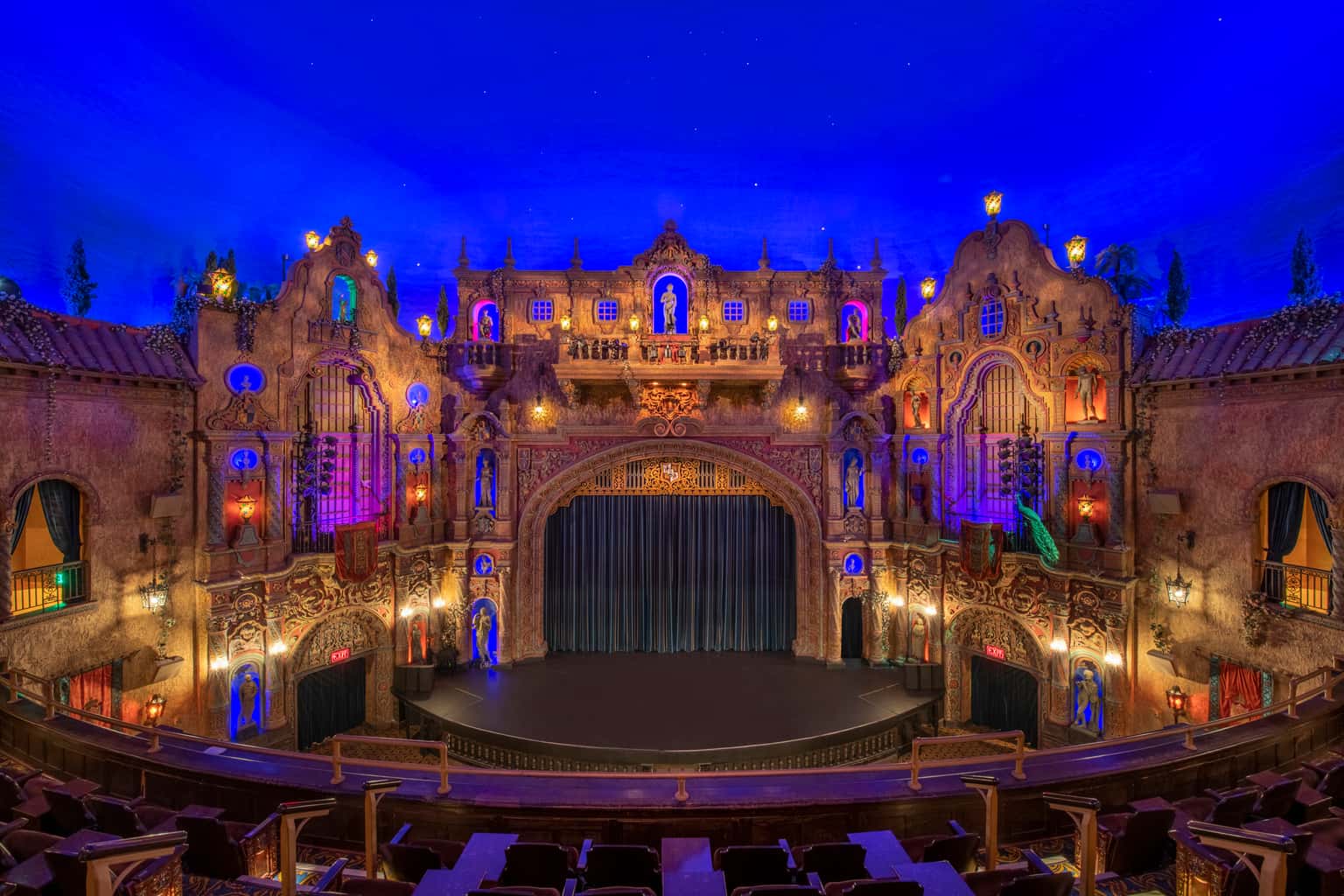
The Tampa Theatre turned 100 on October 15, the same day it opened in 1926 on Franklin Street. Back then a ticket cost a quarter, which put the lavish interior within reach of people who would never have otherwise stepped inside a place like it. The building was designed by Chicago architect John Eberson, who developed and promoted the "atmospheric" style of movie palace. The auditorium seats 1,238 people and is styled as a Mediterranean courtyard, with clay-tile roofs, old-world statues, ivy and gargoyles, all under a star-studded ceiling with 99 "stars" lighting up the night sky. According to George Levesque, the theatre's president and CEO, fewer than 95 atmospheric theatres remain in the United States, and Eberson himself considered the Tampa building his best work.
Every week we pick 🏆 the 5 best 🏆 things to do in Tampa and send them to your inbox. Just one weekly email, no spam.
By submitting your email, you accept our Privacy Policy
The theatre came close to not making it to its centennial. In 1973 it was slated for demolition, but local residents rallied, committees were formed and the Tampa City Council agreed to buy the building and preserve it. It reopened to the public in January 1977, was added to the National Register of Historic Places in 1978 and later became a Tampa City Landmark. The theatre is run by a nonprofit and fills its calendar with first-run and classic films, live concerts, tours, school programs, weddings and corporate events. Since its rescue, it has welcomed more than 5 million visitors, including 1 million schoolchildren on field trips and summer camps. In June 2024 it opened its first expansion in its 99-year history, a 43-seat microcinema next to the Franklin Street Box Office. That box office is open from 10:00 AM to 6:00 PM, Monday through Friday, and on evenings and weekends it opens when doors open for the first show.
The biggest recent project has been the restoration of the historic Duncan Auditorium, which began in March 2026 and was led by EverGreene Architectural Arts. Crews restored every inch of plaster and paint, and forensic paint analysis showed that some colors had changed over the decades: a red had been blue, and a blue had been green. The walls are being repainted in the colors John Eberson originally used, inspired by Florida's wildlife. Large lighting fixtures that hung from the ceiling were taken down and sent to St. Louis for restoration, the incandescent star lights were replaced with fiber optics, and the projector, sound and stage lighting were upgraded to modern systems, including a 4K laser projector. An elevator was also installed. The first phase cost $24.5 million, and the total project is about $30.5 million. The public got to see the finished space during an open house on Sunday, October 11, and a two-floor education center with classrooms for film studies is set to open this fall, in collaboration with the University of South Florida.
The Mighty Wurlitzer organ is another highlight. The instrument was built to accompany silent films and was pulled out of the theatre as talkies took over in the early 1930s. It spent years at Bayshore Baptist church before volunteers from the Central Florida Theatre Organ Society helped bring it back to its original home. Today artist in residence Steven Ball and those volunteers play it before film screenings and during silent film events. Ball grew up on a farm in rural Michigan, studied the organ at the University of Michigan, and has described the instrument as designed to sound like a full orchestra, with most of it hidden in the walls. He estimates that fewer than 40 theatre organs survive in their original homes. The second phase of the restoration, about $6 million to $6.5 million and estimated to finish in 2028, will restore the organ and create a third public programming space. The centennial wraps up on Sunday, October 25, with Buster Keaton's 1924 silent comedy Sherlock Jr., accompanied by the Mighty Wurlitzer and the Paragon Ragtime Orchestra, and a performance of Tchaikovsky's 1812 Overture will close the evening.
Published Date
18 October 2026
More information