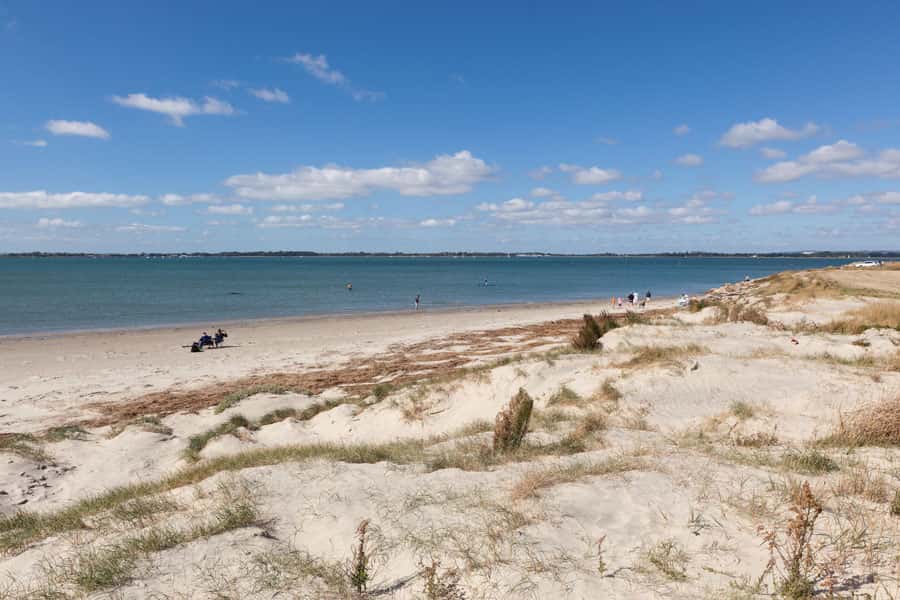
Thorney Island is not actually an island, but a wooded peninsula in Chichester Harbour on the south coast of West Sussex, cut off from the mainland by a narrow channel called the Great Deep. Most of it is a military base held by the Ministry of Defence, but a perimeter footpath runs around the edge, so you can walk the whole thing as long as you are happy to be buzzed through a couple of security gates.
Every week we pick 🏆 the 5 best 🏆 things to do in Southampton and send them to your inbox. Just one weekly email, no spam.
By submitting your email, you accept our Privacy Policy
The Thorney Island Coastal Path is an eight-mile circular route that is flat and easy going, taking somewhere between two and a half and three and a half hours. It is the first section of the Sussex Border paths, which carry on for another 170 miles east to Rye. There are two ways to start: park in Emsworth and head south to do the loop counter-clockwise, or park at the small waterfront car park in Prinsted village, postcode PO10 8HS, and go clockwise. A path runs between the two, so you can link them up and complete the full circle either way.
Security is the one thing worth planning around. There is a gate about a mile in on each side of the island, and you have to press a buzzer to be let through by base security. Both gates shut at 6 pm, so if you start late you could get locked out of the far side and be forced to turn back. Once you are through, the rule is simple: stay on the footpath and do not wander onto military land. There are no facilities on the island at all, and nowhere to leave rubbish, so whatever you carry in you will need to carry back out.
The southern tip is the real draw, an RSPB nature reserve on Pilsey Island, which a sandbank has now joined to the main land. It is one of the best bird-watching spots in Chichester Harbour, and in winter it holds a huge number of waterbirds and waders, with more than a thousand oystercatchers, grey plovers and dunlins. Little egrets, grey herons, peregrine falcons and various warblers are all regular visitors, and you are just as likely to spot foxes as you are birds. The tide changes the place completely, too: at low water, white sandy beaches appear at the southern end, so it is worth checking the forecast before you set off.
For a bit of history, the island served as an airfield during the Second World War, and that military past still shapes it. The wider harbour is part of the Chichester Harbour National Landscape, a 29-square-mile estuary that has been protected since the 1960s, and the Chichester Harbour Conservancy looks after the leisure, recreation and conservation across the whole area.
It is worth noting that the full loop was closed for a while in 2025 after a sluice gate was damaged, but a new gate was fitted on the eastern side in August, so the whole eight miles are open again. If you are after a quiet, flat walk with plenty of wildlife and a bit of unusual character, it is hard to beat.
Published Date
13 September 2026
More information