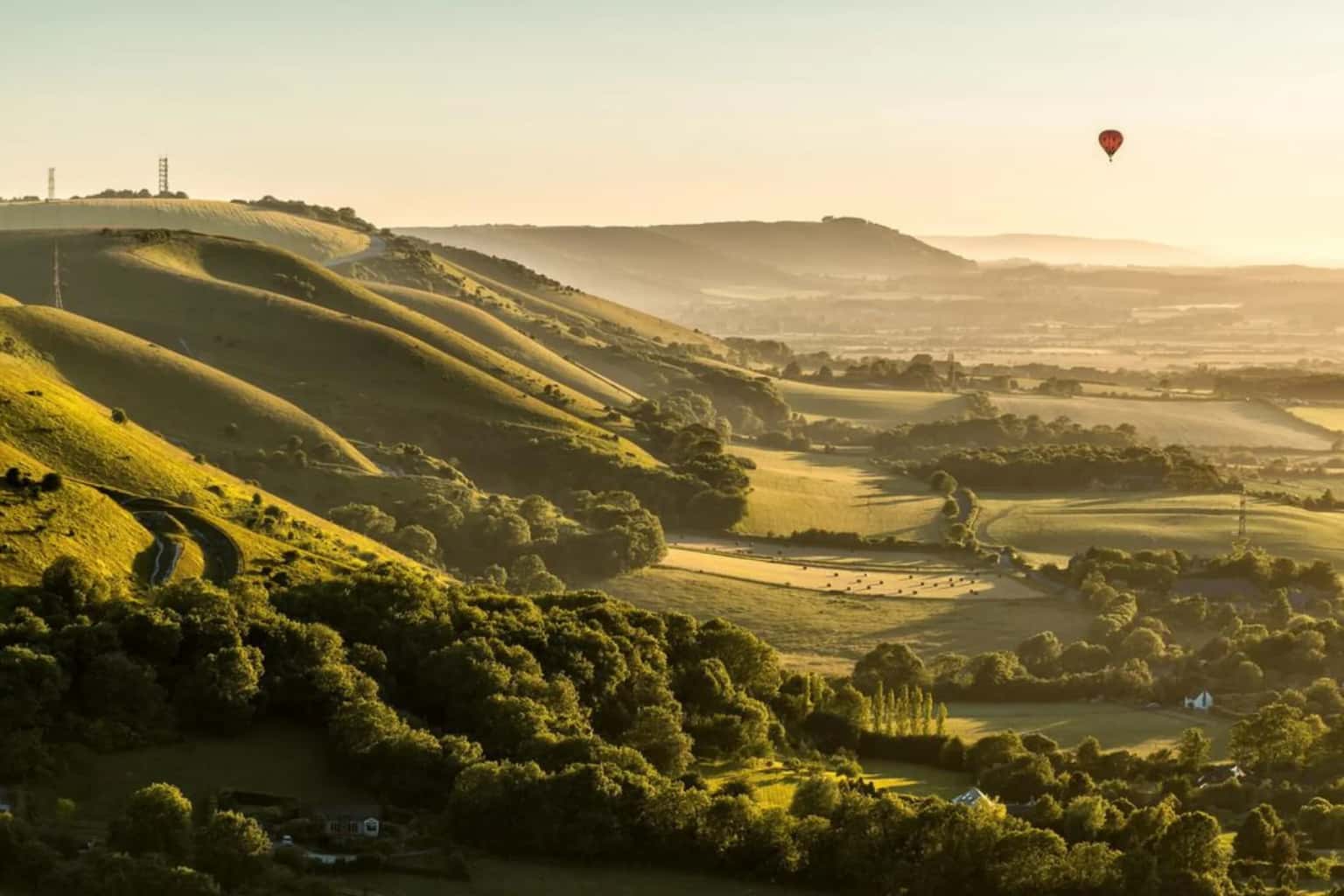
If you fancy a bit of autumn gloom, the South Downs have a ready-made Halloween trail. Thirteen of the spookiest spots across the National Park make for a thematic route, and most are within reach of Portsmouth for a day or two out.
Every week we pick 🏆 the 5 best 🏆 things to do in Portsmouth and send them to your inbox. Just one weekly email, no spam.
By submitting your email, you accept our Privacy Policy
The most storied start is the Cowdray Ruins in Midhurst, West Sussex. A grand Tudor house, it was gutted by fire in 1793, and some still link the blaze to a curse predicted by a monk from Battle Abbey. The Grey Lady is the ghost most reported here, seen on the Lady's Walk. A bit further, the Winchester Green Men are carved faces on the walls of Winchester Cathedral, foliage sprouting from their mouths, eyes, noses and ears.
Hinton Ampner in Bramdean is said to be haunted by a ghost army of defeated Civil War soldiers from the Battle of Cheriton, fought in 1644. The current house is a 20th-century Georgian-style building, but the site has a long history of hauntings, including a 1950s incident where footsteps and voices were reported before workers found a hidden brick chamber containing skeletal remains. Tichborne carries the legend of the Dole of Tichborne, a flour charity tradition said to have been cursed by Lady Mabella, with the deaths of several heirs and the burning of the house to follow. At Marwell Hall in Owslebury, the Mistletoe Bride is said to have disappeared on her wedding night, trapped in a chest and left to die, and now haunts the hall.
The heathlands around Bordon, Petersfield and Haslemere are known for bats at dusk and misty mornings with corvids kronking in Longmoor, and Bramshott is sometimes called England's most haunted village, with reports of highwaymen, murders and the ghost of a military railway. Kingley Vale holds Bronze Age burial mounds and Iron Age camps, with the Kings' Graves, or Devil's Humps, said to be the resting place of Viking leaders buried in 894, their yew trees supposedly taking human shape. Racton Ruins, a folly built in the 1770s north of Westbourne, is linked to bricks thrown from the tower, a ghostly woman and a ghost tractor in the fields; a 4,000-year-old Bronze Age skeleton, Racton Man, was found here in 1989 and is now at The Novium Museum in Chichester.
Chanctonbury Ring on Chanctonbury Hill is a pre-Roman hillfort from the Late Bronze Age or Early Iron Age, surrounded by beech trees planted in 1760, many lost in the Great Storm of 1987. Legend has it that walking seven times anticlockwise around the ring summons the Devil. Upwaltham is tied to Ol' Sary Weaver, a 19th-century wise woman said to turn into a rabbit, while Devil's Dyke is said to have been dug by the Devil to stop the Christian conversion of Sussex, the earth he threw aside forming Chanctonbury, Cissbury, Rackham Hill and Mount Caburn. Mount Caburn, near Glynde, rises 150 metres and tells of a giant named Gil who threw his hammer from the summit, with a nearby barrow known as Gil's Grave. Finally, the Long Man of Wilmington on Windover Hill is one of only two human hill figures left in England, 235 feet high and now made of white-painted breeze blocks and lime mortar, with theories about its origin ranging from a prehistoric fertility symbol to a 16th-century carving.
Published Date
17 October 2026