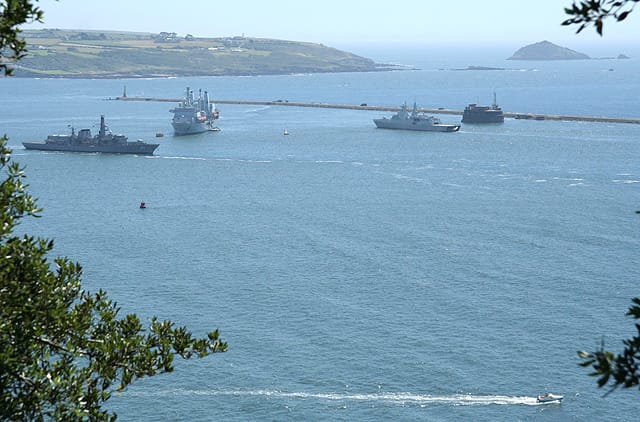
Plymouth has always been a city defined by what floats past it, and there is a new way to take that in from the water. R.C. Thomas, the Plymouth Laureate of Words for 2025 to 2027, is leading a boat trip across Plymouth Sound that turns the city's waters into both the setting and the subject, pairing a live voyage with the myths and folktales tied to the Sound.
Every week we pick 🏆 the 5 best 🏆 things to do in Plymouth and send them to your inbox. Just one weekly email, no spam.
By submitting your email, you accept our Privacy Policy
It is a natural fit for the man at the helm. Thomas is a writer, illustrator, musician and creative-writing teacher who tends to work across mediums, blending writing with music, visual art and public installations. He teaches adults and children across Plymouth and has published four books: The Strangest Thankyou in 2012, Zygote Poems in 2015, Faunistics in 2024 and Infinity Strings in 2025. His Laureateship is built on creative-writing commissions, public events and community engagement, delivered alongside Literature Works, Plymouth Culture and The Box.
This is not his first foray into the intersection of image and story. He has previously run Journeys with Myth & Image, a poetry workshop at The Box that used image-poems as a way into cultural mythology and folklore, drawing on contemporary Pacific Island visual poetry and art and linking to the Journeys with Mai exhibition. That session, delivered with Literature Works, cost £10 for a standard ticket. The Sound voyage takes that same interest in mythology and carries it out onto the water, using the city's maritime identity as the thread.
To understand what is being narrated, it helps to know the stretch of water in question. Locally known as The Sound, it is a deep strait and the entrance to the English Channel near Plymouth, roughly six kilometres long and six kilometres wide, with the Hamoaze forming its main entrance. Its southwestern and southeastern corners are Penlee Point in Cornwall and Wembury Point in Devon, about three nautical miles apart, while Plymouth Hoe marks its northern limit. It takes in three water entrances: a marine one from the English Channel, with a deep-water channel west of the Plymouth Breakwater; a freshwater one from the northwest, where the River Tamar flows through the Hamoaze and Devonport Dockyard; and another from the northeast, where the River Plym enters the Cattewater harbour between Mount Batten and the Royal Citadel. A whole catchment of smaller rivers feeds into it, from the Lynher and the Tavy to the Wallabrooke and the Walkham.
At the centre, between Bovisand Bay and Cawsand Bay, the Plymouth Breakwater shelters moored vessels from the frequent south-westerly storms. Built from 1812 under John Rennie and Joseph Whidbey, it runs about 1,700 yards and rises some 11 metres above the water, with a 23-metre lighthouse at its western end and a smaller eastern one topped by a spherical cage, traditionally described as a safety device to keep shipwrecked sailors from being swept off the low breakwater. Drake's Island sits in the northern Sound, fortified to defend Drake's Channel, the only deep-water route to Devonport. The traffic that passes through is a cross-section of the city's working life: Royal Navy vessels, commercial ships, ferries to France and Spain from Millbay Docks, fishing boats from Sutton Harbour and leisure craft from the marinas at Sutton Harbour, Mount Wise and Turnchapel, all controlled by the King's Harbour Master for Plymouth.
And the history is hard to overstate. The English Fleet assembled here in 1355 before the Black Prince left for the Battle of Poitiers; Sir Francis Drake's Pelican began its circumnavigation from Plymouth on 15 November 1577; the Mayflower departed in 1620; Napoleon was brought here after surrendering in 1815; HMS Beagle left Barn Pool beneath Mount Edgcumbe on its second survey voyage in 1831 with Charles Darwin aboard; and Francis Chichester set off on 27 August 1966 to sail solo around the world, returning in May 1967. It is a lot of history for one stretch of water, and a fitting backdrop for a voyage built on the stories it has left behind.
Published Date
21 August 2026