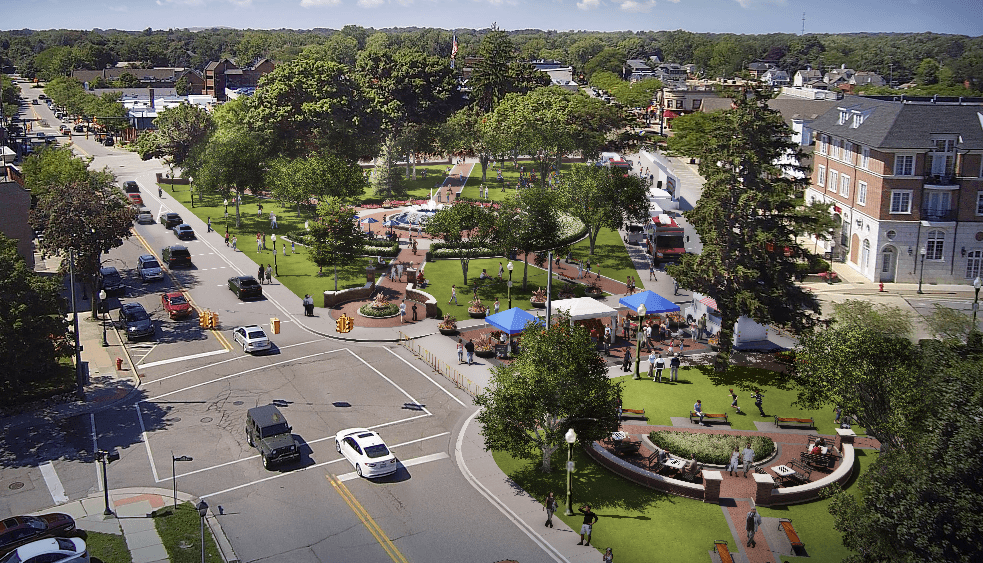
Plymouth is the kind of town that rewards a slow walk. Most people come for the obvious draws, but the real character is in the details you'd drive past without a second look. Start at Kellogg Park, the green at the centre of downtown, and you'll find the first one: the welcome signs scattered around town, designed by Tivadar Balogh. He was a Detroit-born architect and Navy veteran who left more than 150 projects across Michigan, Illinois and Arizona, and his signs have quietly become part of the city's identity. His own home, built in the late fifties, made the National Register of Historic Places in 2013.
Every week we pick 🏆 the 5 best 🏆 things to do in Plymouth and send them to your inbox. Just one weekly email, no spam.
By submitting your email, you accept our Privacy Policy
Across from the park sits the Penn Theatre, a restored single-screen cinema from the 1940s that still does what it was built for. It opened on 4 December 1941 with 'Weekend in Havana' and has since taken in more than 779,000 patrons. It's run by the Friends of the Penn, a federally recognised non-profit, and keeps things simple: all seats are £3.80, the box office opens half an hour before showtime, and there are no advance tickets. This week it's showing 'YOUNG WASHINGTON' at 7pm on Thursday, Friday and Saturday, and 5pm on Sunday.
For the history, head to the Plymouth Historical Museum at 155 S. Main Street. It's open 1pm to 4pm on Wednesday, Friday, Saturday and Sunday, with adults at £5.30 and students aged 6 to 17 at £2.30, and the museum store is free to browse. The collection runs from the early pioneers through the Civil War and President Lincoln, and it holds a piece of the original Plymouth Rock, a gift from Plymouth, Massachusetts during the Second World War, now on display in City Hall. The centrepiece is a Victorian Main Street exhibit, a full-scale reconstruction with authentic artefacts, and the current exhibition, 'America 250 Part II: 1900-2026', runs until 1 November. A Wilcox House tour is lined up for 16 August, 1pm to 4pm.
That same museum covers the town's claim as the air rifle capital of the world, which started when the Daisy Manufacturing Company made the first BB gun here in 1882. If you're wandering, keep an eye out for the Old Village, the historic district of independent shops and cafes, and the site of the old four-way railroad crossing, once the only place in Michigan where tracks crossed in all four directions. None of it is a headline attraction, but together it's what gives the place its shape. Between the galleries, the restored cinema and the museum, there's a lot more to see here than the usual tourist loop suggests.
Published Date
24 July 2026
More information