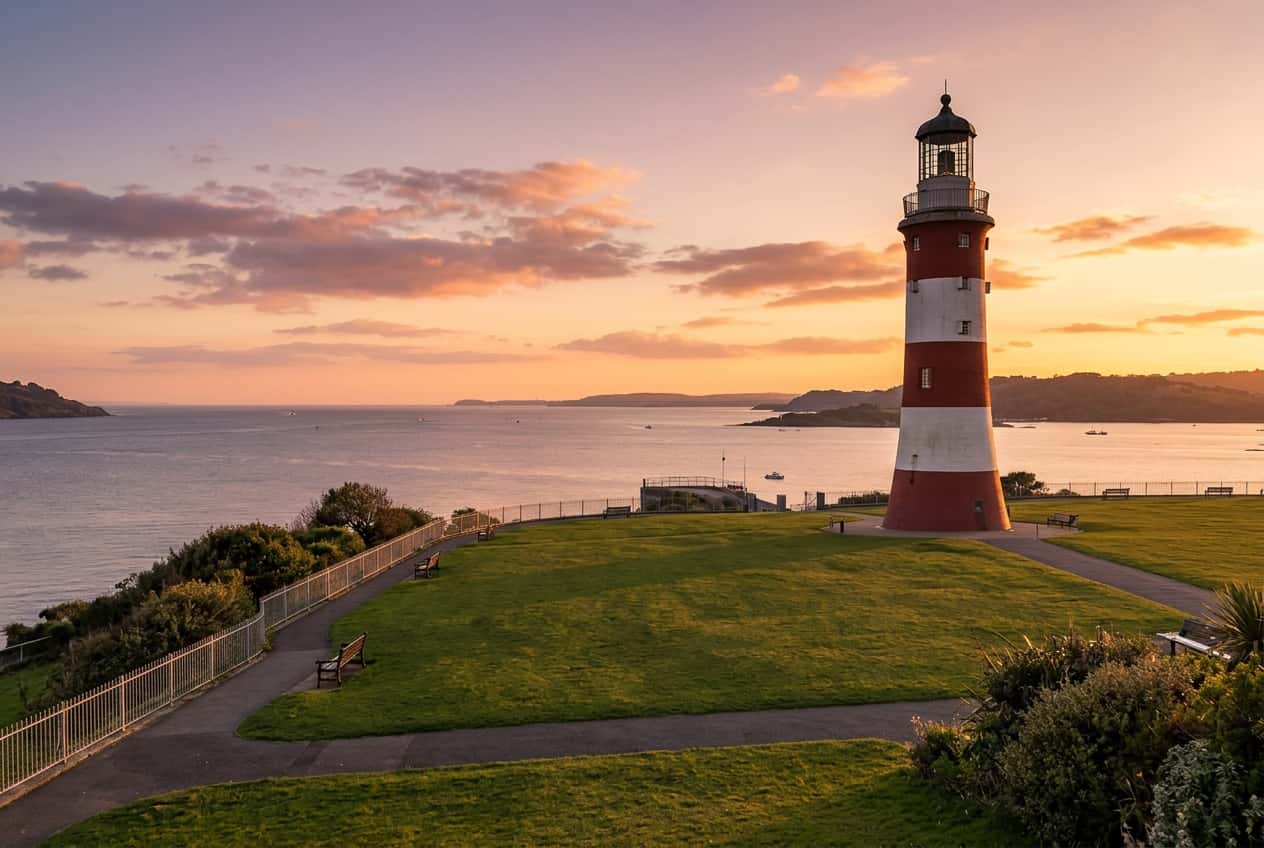
Plymouth is a city that wears its maritime history on its sleeve, but look past the obvious landmarks and there is a quieter, stranger layer of art and architecture waiting to be found. A good way to see it is to start on the Hoe, then head inland to Central Park, and finish by hunting down the public art scattered across the city centre.
Every week we pick 🏆 the 5 best 🏆 things to do in Plymouth and send them to your inbox. Just one weekly email, no spam.
By submitting your email, you accept our Privacy Policy
On the Hoe, Smeaton's Tower is the obvious starting point. The red-and-white striped monument reopened for the 2025 season, and you can climb 93 steps to the lantern room for views across the Hoe. It sits within the Plymouth Sound National Marine Park, the first of its kind in the UK, and has been Grade I listed since 1954. It is the third of four lighthouses built to mark the Eddystone Reef, a dangerous stretch of rocks about 14 miles to the southwest where, before a light went up, around 50 ships were lost a year. The original Smeaton's Lighthouse stood on the rocks from 1759 to 1877, and the tower you visit now is a land-based version of that work. John Smeaton, born in Austhorpe, Yorkshire in 11724, is widely called the father of civil engineering.
For something more ghostly, look for Winstanley's Lighthouse. Henry Winstanley, an Essex-born painter and engineer, built Plymouth's first lighthouse on the Eddystone Rocks in 1698 after losing two of his own ships there. The original tower was swept away by a storm in November 1703, and Winstanley disappeared with it. You will not find the building itself, but the story lives on in art: a camellia-pink painting of the lighthouse hangs in the Mount Edgcumbe estate, and William Daniell's 'Eddystone Lighthouse, During a Storm' is held at The Box.
From there, head to Central Park, the city's largest green space, which was created in 1928 on farmland bought by the council from Lord St Levan. The park is full of the kind of things you only notice if you are looking for them. Near the cemetery entrance, a Green Man is carved into a tree trunk, complete with a wooden lizard plaything; the name was first used by Lady Raglan in 1939 and the figure is linked to May Day and fertility. Over by the foot golf area, Neptune's face peers out from a stone, possibly a keystone from bomb-damaged 'tip fields'. And near Pounds House, the 'Ode to Elm' uses Sapporo Autumn Gold trees that fell in a storm to celebrate those resistant to Dutch elm disease.
Pounds House itself is worth a stop. Built for banker William Hodge in the early 19th century, it is one of the few surviving Georgian houses in Plymouth and is Grade II listed. The council bought it in 1927 and opened it as part of the park in 1931, and over the years it has been a cafe, a wedding hall, a public library and, during the Second World War, the Air Raid Precautions area headquarters. It has sat empty since 2017 and was put up for auction in late 2026, so its future is still being decided.
To round it off, a stroll through town reveals a surprising amount of public art. There is a dove on Alma Road, the Leviathan at the Barbican, King Billy on Mount Wise, and the Plymothian Heart back on the Hoe. Look for the ship's biscuit outside Royal William Yard, the dragonfly near the Council House, and Isambard Kingdom Brunel hidden in the Pennycomequick roundabout. It is a city that rewards a slow walk and a keen eye.
Published Date
13 November 2026