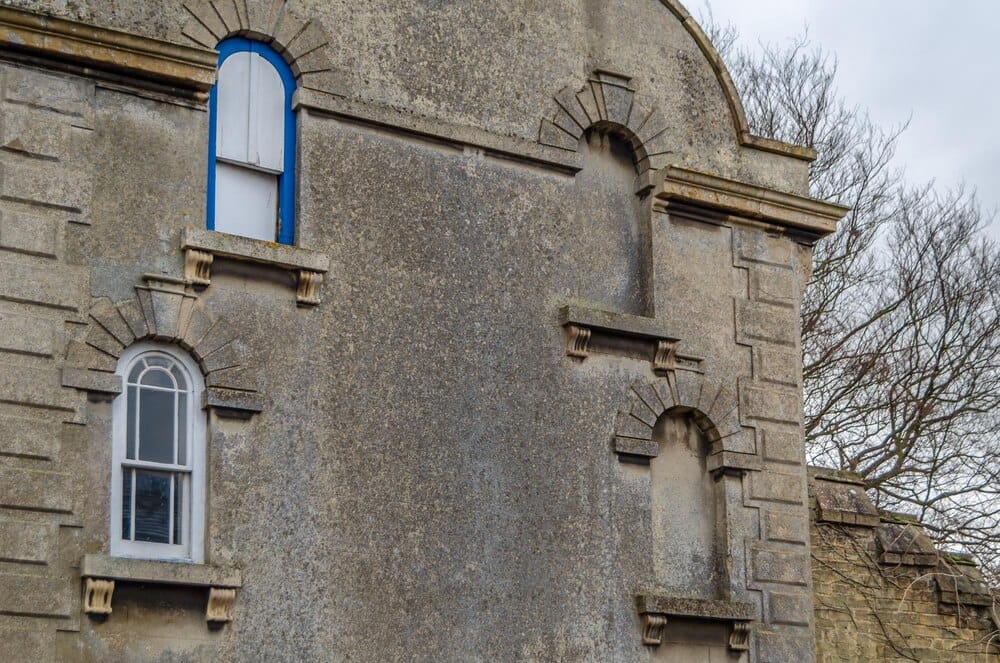
Plymouth is a city that wears its history in layers, and some of the most interesting bits are the ones you walk past without ever noticing. A bit of looking up reveals a quieter, more eccentric side to the place: tiles tucked above buildings on Market Avenue, a sculpture perched above a doorway on Courtenay Street, and the lion-headed gargoyles of North Hill. Among them is Davie Hall's pentagram, a symbol long associated with witchcraft, and at Sherwell United Church, pineapple-shaped windows that nod to the fruit's old role as a sign of hospitality among the European gentry.
Every week we pick 🏆 the 5 best 🏆 things to do in Plymouth and send them to your inbox. Just one weekly email, no spam.
By submitting your email, you accept our Privacy Policy
That pineapple theme runs deeper than one church, too. The Facebook page 'Plymouth Street Scenes' has dubbed it 'PineappleGate', and the motif turns up on houses along Plymbridge Lane, at the St Aubyn Masonic Hall, and even on the handrails in Tothill Park. Back in 2017, the crumbling pineapples atop Charles Church, each weighing a tonne, were replaced with new copies as part of a £100,000 makeover.
Much of the city's shape comes from the aftermath of the Blitz. In 1943, architect Sir Patrick Abercrombie envisioned a new Plymouth built around broad central roads and Armada Way, which stretches from North Road railway station down to the Hoe. Today, the Plymouth Architectural Trust, chaired by Win Scutt, is working to keep that twentieth-century fabric going, with sixteen city-centre facades chosen for a professional clean using a specialist steaming technique, partly funded by Historic England.
One of the buildings getting the treatment is the Pearl Assurance House, an imposing 1950s block on the corner of Armada Way and Royal Parade, designed to hold its own against the nearby Plymouth Guildhall with its embellished columns and carved stonework. It was granted up to £49,900 for façade cleaning and repair, which included cleaning 14 shop frontages to bring back the light Portland Stone. Its corner lines up with the neighbouring Dingles building, now House of Fraser, and Thomas Tait, one of the architects of the Sydney Harbour Bridge, had a hand in its design.
There are plenty more oddities scattered about. A mysterious blue plaque above Flannels marks the site of the Frankfort or West Gate, which dates to the early fifteenth century and was taken down in 1661 and 1783. The former Alliance Building Society on Royal Parade carries an official blazon granted on 8 June 1954, with the motto 'Domus Arx Certissima' — the surest stronghold is the home. Over on Mannamead Road, a fairy house has turned up, with another thought to be on Ernesettle Lane. And the Slug and Lettuce in Berkeley Square is actually a listed former Barclays Bank, built between 1950 and 1952 by Curtis Green, Son and Lloyd, with sculptures by William McMillan, including an ARP warden or firefighter. Even the University of Plymouth has its own contribution: a sculpture of a man reading a book, caught in the act of walking out of the library. It's the kind of city that rewards you for slowing down and looking up.
Published Date
25 July 2026
More information