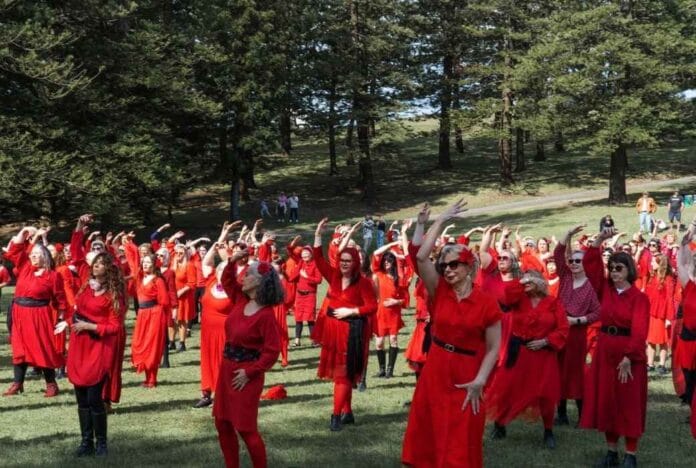
Newcastle's most eccentric annual tradition has a bit of a gap in its record this year. Wuthering Heights Day, the quirky celebration that turns the city red for a day, was due to return on Saturday 18 July at the Newcastle Civic Centre, but the 2026 edition was cancelled because of the Newcastle earthquake. For anyone who has never come across it, it is a family-friendly event that wears its oddity on its sleeve: participants dress in red to lean into the passion and revenge of Emily Brontë’s only novel, and the centrepiece is a red-dress parade, with live music, a Brontë family history talk and a children’s workshop rounded it out.
Every week we pick 🏆 the 5 best 🏆 things to do in Newcastle and send them to your inbox. Just one weekly email, no spam.
By submitting your email, you accept our Privacy Policy
The whole thing is part of something much bigger. Newcastle's day sits inside 'The Most Wuthering Heights Day Ever', an international celebration where people recreate the music video for Kate Bush’s 1978 song 'Wuthering Heights'. The idea started with 'The Ultimate Kate Bush Experience', staged by the performance collective Shambush! at the Brighton Fringe in 2013, which tried to set an unofficial world record for the largest gathering of people dressed as Kate Bush and pulled in hundreds. Since 2016, the celebration has spread across Australia, Europe, North America and New Zealand, with Newcastle on the list since 2016 and appearing again in 2018, 2019 and 2024. The 2026 programme kept going elsewhere, with Adelaide on 2 August and several other Australian dates through July, so the spirit lived on even while Newcastle sat it out.
It is worth knowing what the day actually honours. Emily Jane Brontë was born on 30 July 1818 and died on 19 December 1848 at the age of 30, a year after Wuthering Heights was published. She was one of three Brontë sisters, alongside Charlotte and Anne, and the fifth of six children. Her mother died when she was young, and she was educated mostly at home by her father, Patrick Brontë, a curate in Haworth. She was closest to Anne, and together they built imaginary worlds like Glass Town, Angria and Gondal, filling notebooks with prose, poetry and diaries. In 1846, the sisters published Poems by Currer, Ellis and Acton Bell under male pseudonyms, with Emily writing as Ellis Bell. Wuthering Heights came out in London in December 1847 under that same name, and her real identity was only revealed after she died.
The novel itself is set on the West Yorkshire moors and follows the Earnshaw and Linton families, their estates, and the adopted son Heathcliff, whose life of revenge and obsession drives the plot. It is a classic of English literature, blending Romanticism, gothic fiction and tragic romance, and it has been adapted countless times: from the 1939 film starring Laurence Olivier to a 2025 musical in Sydney and Emerald Fennell’s 2026 film with Margot Robbie as Catherine Earnshaw. The Brontë connection remains alive in Haworth, where the Brontë Parsonage Museum stands on the home where the sisters lived and wrote. So while Newcastle missed its red-dress moment this year, the story behind it is far from over.
Published Date
18 August 2026