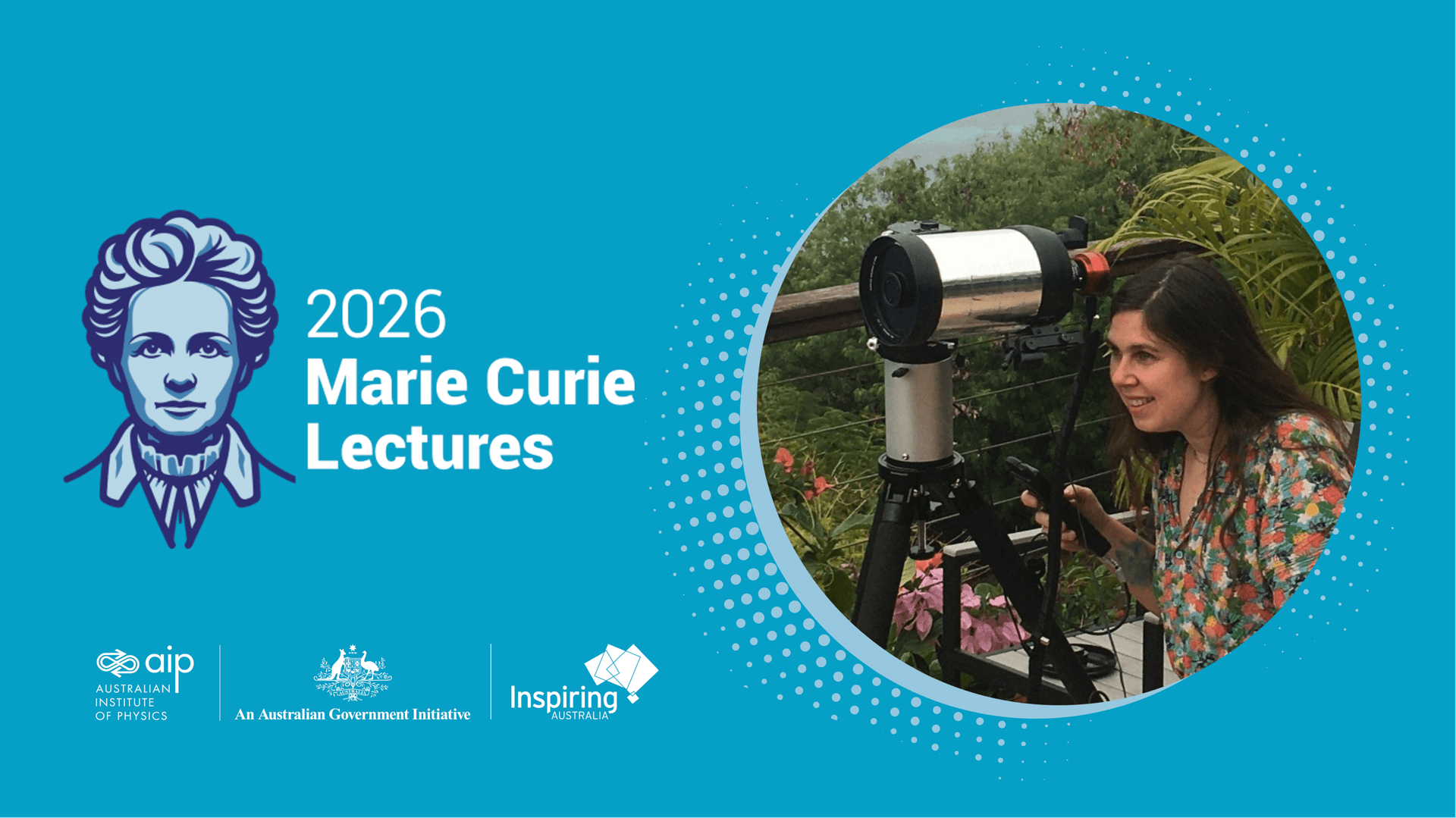
If you have ever wondered where the atoms in your own body actually came from, there is a talk coming to Newcastle that lays it out in a way you can actually picture. The Marie Curie Lecture returns to the city as part of National Science Week 2026, and this year's session is titled 'Painting the Universe: A Visual and Musical Exploration of Space-Time'. It is being put on by the Australian Institute of Physics in collaboration with the City of Newcastle and the University of Newcastle's School of Science, so it has some serious backing behind it.
Every week we pick 🏆 the 5 best 🏆 things to do in Newcastle and send them to your inbox. Just one weekly email, no spam.
By submitting your email, you accept our Privacy Policy
The person at the centre of it all is Dr Karelle Siellez, a French astrophysicist and lecturer at the University of Tasmania. She specialises in multi-messenger astronomy, which is a fancy way of saying she looks at the universe using more than one type of signal at a time. Her work was part of the first detection of a gamma-ray burst and gravitational waves coming from the same cosmic event, a breakthrough that earned a 2017 Breakthrough Prize. Beyond the research, she is an award-winning science communicator known for weaving art, sound and storytelling into her presentations, which is exactly what 'Painting the Universe' is built on.
The talk itself lands on Friday 21 August at the Newcastle Museum, over at 6 Workshop Way in Honeysuckle. Doors open at 6:00 pm with refreshments available, the talk kicks off at 6:30 pm and wraps up around 7:45 pm, so it is a tidy evening rather than a long haul. Tickets are A$10 for adults and free for anyone under 18, though there are additional ticket and processing fees on top. Bookings are essential, and the session is geared towards ages 10 and up, with younger children welcome as long as there is adult supervision. If you have any access or inclusion needs, you can flag them when you book.
As for what you will actually hear about, the lecture follows gravitational waves and the massive collisions that forge the elements we are made of, using 'multi-messenger' signals like kilonovae and gamma-ray bursts to tell the story. It is supported by the Australian Government's Inspiring Australia initiative, and the museum itself gets backing from Create NSW. If you cannot make it in person, the AIP is livestreaming the event through its website, so you can still catch it from home.
It is worth knowing where this fits into the wider week. National Science Week 2026 runs from Saturday 15 to Sunday 23 August, with the schools theme 'Seeds of Science: Nurturing knowledge for all'. The Newcastle Museum is a fitting place for it, too: it opened to the community back in 2011 inside the old Honeysuckle Railway workshops and keeps permanent exhibitions like 'A Newcastle Story', 'Fire and Earth' and 'Supernova' going year-round. For anything you cannot find online, the museum can be reached on 02 4974 1400 or enquiries@newcastlemuseum.com.au, and the AIP takes enquiries at aip@aip.org.au.
Published Date
4 August 2026
More information