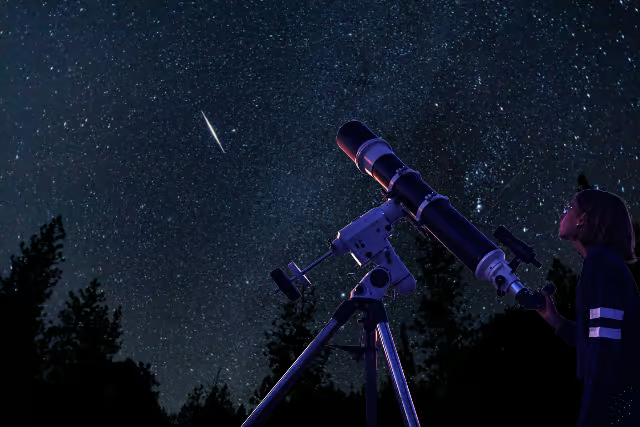
The Orionid meteor shower is hitting its peak this week, and from around Leeds you can catch up to 20 shooting stars an hour if you pick your spot and your timing right. The shower runs from 2 October to 7 November, with the broad maximum centred on the night of 21 October, so the best window is the next few days.
Every week we pick 🏆 the 5 best 🏆 things to do in Leeds and send them to your inbox. Just one weekly email, no spam.
By submitting your email, you accept our Privacy Policy
Timing is the tricky part. The radiant, the constellation Orion, only rises around 10pm, and the best viewing is between midnight and 5.30am, with the rate picking up towards the early hours. The Moon is the main spoiler this year: it's in a waxing gibbous phase and about 80% lit on 21 October, which washes out a lot of the fainter meteors. It doesn't set until 3am, so the real moonless hours are the ones to aim for.
Leeds itself is a tough place to watch from, with Bortle 7-8 light pollution, but the good news is that some of the darkest skies in the country are within easy reach. The Yorkshire Dales are only 30 to 40 minutes away, and around Malham and upper Wharfedale you drop down to Bortle 3-4, where the Milky Way comes out on a moonless night. The North York Moors to the east and the Pennines are also excellent, with upper Wharfedale and Hawes being popular spots for anyone willing to drive a bit further for a proper view.
There's no need for a telescope or binoculars; the naked eye is actually the best way to take it in, as it gives you the widest view of the sky. The only real trick is patience: your eyes need about 20 to 30 minutes to fully adapt to the dark, so leave the phone in your pocket and give your vision time to adjust.
It's worth knowing what you're actually looking at. The Orionids are one of the most reliable annual showers, and they're created by debris left behind by Halley's Comet, which orbits the Sun every 75 to 76 years and last passed near Earth in 1986. The meteors take their name from the constellation Orion, which they seem to radiate from, and they're notably fast, hitting the atmosphere at around 41 miles per second. Halley's Comet itself won't be visible again until 2061, so these annual showers are the only way to catch a glimpse of its trail in the meantime.
If you're heading out, a few tips make the difference. A warm layer and a thermos are obvious, but a red torch or a dim light will help you move around without ruining your night vision. If you're driving into the Dales, the Yorkshire Dales National Park is the largest Dark Sky Reserve in the UK, with a core area around Hawes where residential lighting is already 90% dark-sky friendly. The park has four designated Dark Sky Discovery Sites — the visitor centres at Hawes and Malham, the Buckden car park and the Tan Hill Inn — which are all good places to start. On a clear, moonless night out there, you can see as many as 2,000 stars, the Milky Way, planets and the occasional meteor, so it's well worth the short drive for a proper look up.
Published Date
19 October 2026
More information