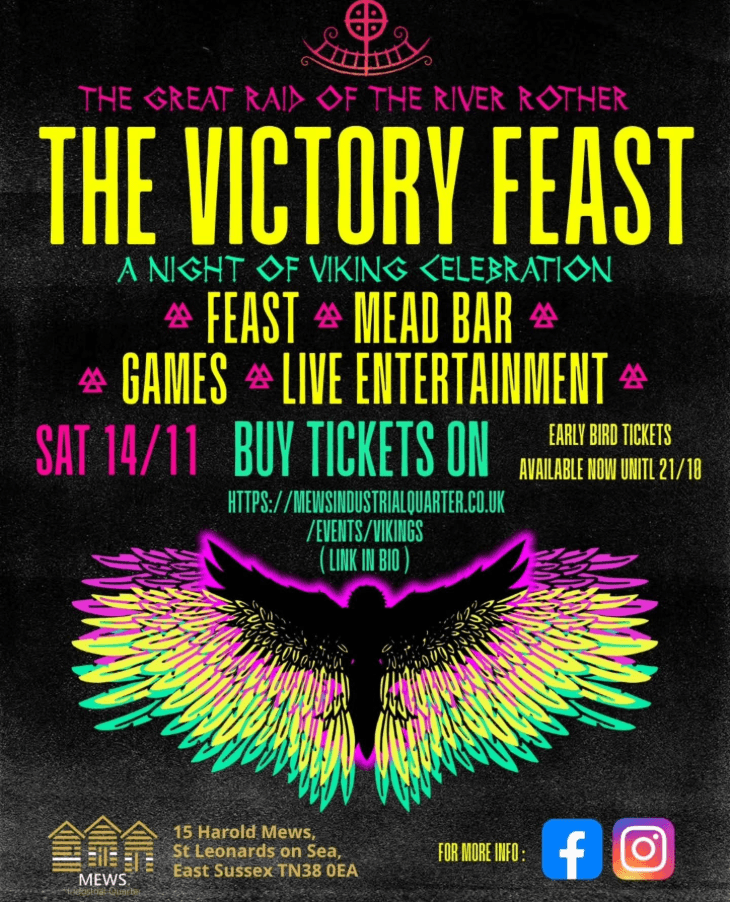
Hastings has a long history of Norse raids, and the Viking Victory Feast is the town's way of leaning into it. The next edition, billed as The Great Raid of the River Rother, lands on Saturday 14 November, from 6pm to 11pm at the Mews Industrial Quarter's MIQ Event Space on Harold Mews in St Leonards. It is part of the town's year-long programme marking the 1,000th anniversary of William the Conqueror, so the timing is no accident.
Every week we pick 🏆 the 5 best 🏆 things to do in Hastings and send them to your inbox. Just one weekly email, no spam.
By submitting your email, you accept our Privacy Policy
The evening is built around a specific historical moment: the Great Raid of the River Rother in the late autumn of 892, when a fleet of 250 longships crossed the Channel from Boulogne. That sets the scene for everything that follows. It starts with a Skál welcome, where you raise a horn of mead, and then settles into a feast at longtables. Between courses there is plenty to keep you busy: Kubb, Meier, also known as Liar's Dice, Flyting, which is essentially a Viking rap battle, and Hammerschlagen. The visual side of the night is directed by Battle Cat, with Chris Young taking the role of Jarl and musician Andrew Harlsten playing the Skald.
The food is the centrepiece, and it is tied to the region. The menu works with seasonal produce from East Sussex and Kent, and the drinks follow suit, with traditional honey mead, Biddenden Cider and wines from the Sussex Weald vineyards. Tickets start at £45 and cover entry, a welcome drink, the multi-course meal and all the interactive entertainment, so there is no hidden extra once you are through the door. They are sold through mewsindustrialquarter.co.uk.
For anyone who wants to know where the Norse connection fits into the wider story, the Battle of Hastings was fought on 14 October 1066 between the Norman-French army of William, Duke of Normandy, and the English army under Harold Godwinson. It took place about seven miles northwest of Hastings, near Battle, and ran from 9am until dusk, which fell at 4.54pm. William had landed at Pevensey on 28 September, and both armies were roughly the same size, somewhere in the region of 7,000 to 8,000 men. William was crowned King of England on Christmas Day that year in Westminster Abbey.
If you want to see the site for yourself, Battle Abbey stands where the battle was fought, and its visitor centre runs interactive displays, an audio tour and an exhibition on the abbey's history. It is open Saturday to Sunday, 10am to 4pm, with last entry at 3pm, and there is a 20% discount if you arrive by public transport or bicycle. The abbey also runs a programme of events, including a Bayeux Tapestry workshop on Saturday 7 November and a talk by Tom Licence on Thursday 19 November, plus a new exhibition for 2026. The tapestry itself, 70 metres of embroidered narrative, is the most famous record of the whole affair, and it is the image of a figure with an arrow in the eye, captioned Here King Harold has been killed, that most people recognise. The feast, by contrast, is the more boisterous side of that history, and it is the one that comes with a meal.
Published Date
7 November 2026
More information