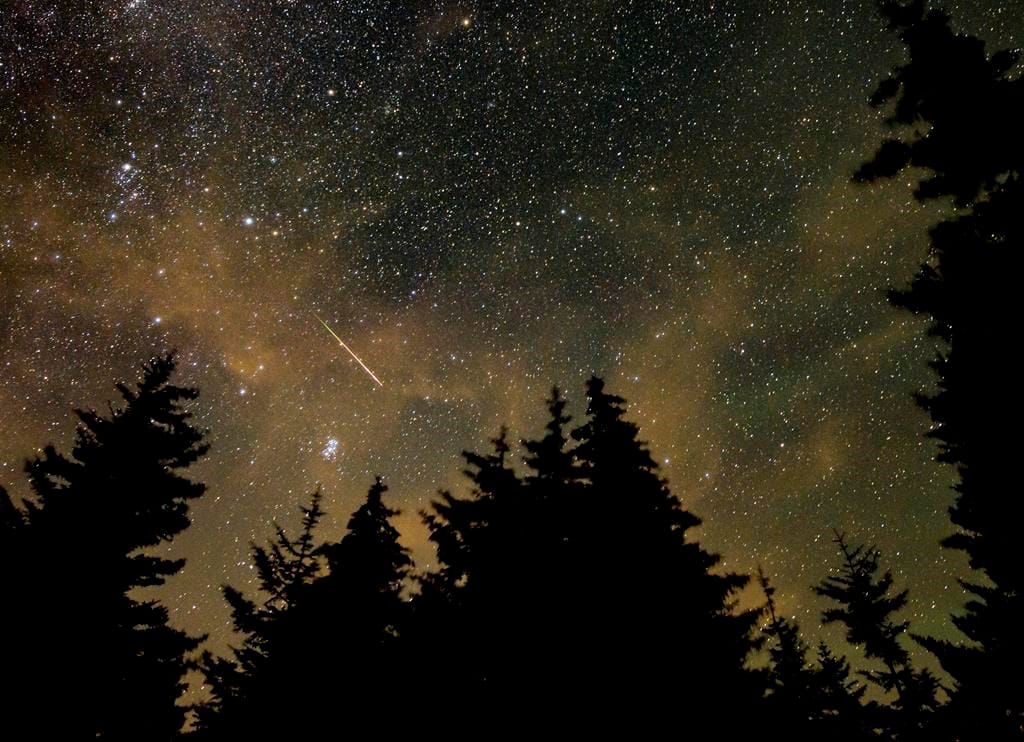
The Perseids are about to peak, and this year the conditions are lining up better than usual. The shower reaches its maximum on the night of August 12–13, with the mornings of the 12th and 13th offering the best viewing. If you can't make those dates, the nights of August 11 and 14 are still worth a look. The shower itself runs from mid-July well into late August, so there's some wiggle room around the peak.
Every week we pick 🏆 the 5 best 🏆 things to do in Halifax and send them to your inbox. Just one weekly email, no spam.
By submitting your email, you accept our Privacy Policy
Under a truly dark sky, you can expect to see 90 or more meteors an hour, with a predicted Zenithal Hourly Rate of around 100. The real bonus this year is the moon: a new moon falls on August 12, which means the sky should stay dark instead of being washed out by moonlight. That's a big part of why this year's peak is shaping up to be one of the better ones in recent memory.
The best time to watch is between midnight and dawn, and the hours just before sunrise on the 12th and 13th are the prime window. The radiant sits in the constellation Perseus, which is where the meteors seem to originate, and it's highest in the sky at dawn. The Perseids are known for being bright and colourful, often leaving persistent trails across the sky, and they're not uncommon to throw off a fireball or two.
Behind the show is Comet 109P/Swift-Tuttle, a massive periodic comet with a nucleus about 16 miles across and an orbit that takes roughly 133 years. It was discovered independently by Lewis Swift of Marathon, New York, on July 16, 1862, and by Horace Tuttle three days later at the Harvard Observatory. The debris it leaves behind is what we see as the Perseids, and the meteors hit our atmosphere at an average speed of 37 miles per second. The comet last reached perihelion in 1992 and isn't expected back until 2125 or 2126, so the shower is the only way to catch a glimpse of its work for a long time.
Because the radiant is so far north, the Perseids are a northern hemisphere shower; they're barely visible south of 30 degrees south latitude. In some Catholic traditions, they're known as the tears of Saint Lawrence, since the peak falls on the anniversary of his martyrdom. Whether you know the history or not, the practical advice is the same: get as far from city lights as you can, give your eyes time to adjust to the dark, and look up between midnight and dawn. The new moon does most of the heavy lifting for you this year, so a clear night is really all you need.
Published Date
10 August 2026
More information