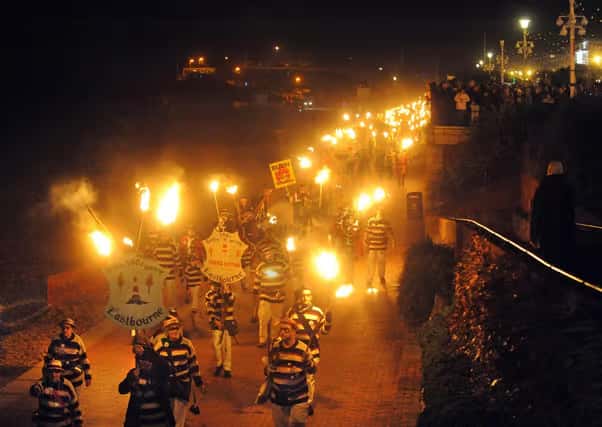
Lewes Bonfire is not your usual bonfire night. It is the largest 5th of November event in the world and the only one of its kind left in the UK, and it has already happened for 2026, so this is a look at what it actually entails rather than a guide on how to get there. The celebrations took place on Thursday 5 November, commemorating the failure of the Gunpowder Plot of 1605 and the execution of the Seventeen Protestant Martyrs of Lewes between 1555 and 1557, whose memory is carried through the night in the form of burning crosses.
Every week we pick 🏆 the 5 best 🏆 things to do in Eastbourne and send them to your inbox. Just one weekly email, no spam.
By submitting your email, you accept our Privacy Policy
At the heart of it all are the independent Bonfire Societies, working under the Lewes Bonfire Council. Depending on who you ask, there were either six or seven societies taking part this year: Cliffe, Commercial Square, Lewes Borough, South Street, Southover, and Waterloo, with the Nevill Juvenile society sometimes counted as a seventh. Between them, around 3,000 people marched in more than 30 processions, and the whole thing was broadcast live from the War Memorial by Lewes the Podcast and Rocket FM.
Each society runs its own firesite, and they are not all the same. Cliffe, founded in 1853, set up on Mountfield Road behind Lewes Leisure Centre, with tickets at £10 sold through local shops and pubs. Commercial Square, from 1855, held its site in the Landport area off Offham Road and charged nothing to enter. Lewes Borough, also from 1853, was up at Landport Bottom at the top of town, £10 for entry. South Street, the youngest of the lot at 1913, took over the Railway Land Nature Reserve near Cliffe Bridge, with under-16s free if accompanied. Southover, founded in 1888 and reformed in 2005, was at Convent Field, and Waterloo, reformed in 1964, set up at Malling Recreation Ground at the bottom of Tesco's, entry free this year with a bucket collection.
The night follows a long-established pattern. Traffic restrictions start early, the town opens around 5pm, and processions begin then, winding through the narrow streets with torches, banners and effigies. The Grand Procession, which brings five of the societies together, runs around 8pm to 9pm and can take an hour to pass. Most bonfires are lit between 9pm and 9.45pm, and the fireworks carry on until around 11pm.
It is worth noting how much the town shuts down for it. Main access roads closed from 4.45pm on the Thursday until 2am on the Friday, and no trains stopped at Lewes, Falmer, Cooksbridge, Glynde or Southease from around 5pm until the next morning. Organisers are clear that the night is not for everyone: the crowds, noise, smoke and steep hills mean it is not suitable for young families, dogs, people with respiratory problems or those with reduced mobility. Sussex Police also warned that anyone bringing their own fireworks would face action. With tens of thousands attending and dozens of injuries reported annually, it is a night that takes itself seriously. If you have never seen it, it is something to watch from a distance first.
Published Date
9 November 2026
More information