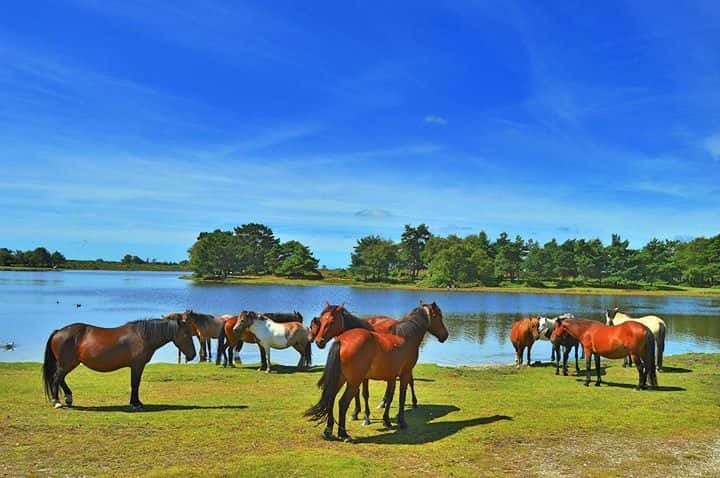
Autumn in the New Forest brings back one of its oldest traditions: pannage. It is the practice of turning pigs out into the woods to forage on fallen acorns, beech mast and chestnuts, a custom that goes back to the time of William the Conqueror, who founded the forest in 1079. The 2026 season is set to run from Monday 14 September to Sunday 29 November, so it is just about to get going.
Every week we pick 🏆 the 5 best 🏆 things to do in Bournemouth and send them to your inbox. Just one weekly email, no spam.
By submitting your email, you accept our Privacy Policy
There is a practical reason behind the tradition. Acorns and beech mast are toxic to the New Forest's free-roaming ponies and cattle, but harmless to pigs, so turning them out to eat the fallen nuts is a natural form of land management. The Verderers of the New Forest, in partnership with Forestry England, decide the exact dates each year. While the season usually lasts around 60 days, it can be extended in a 'mast year' when there is an abundance of acorns.
If you are hoping to see the pigs, there is no single place to go. They roam freely and widely across the forest, so your best bet is a quiet walk through the woods during autumn. A few spots turn up more often than others: the walk between the Bolderwood and Acres Down loops, starting from Millyford Bridge car park; the area around Burley, where pigs can be spotted on a walk from Anderwood; and Denny Wood and Fritham. GPS trackers fitted to a group near Burley have shown that pigs can cover up to 7.5 miles in a day, so they do not stay put.
Around 600 pigs and piglets are turned out each autumn, and you are likely to see hardy native breeds like the Tamworth, Gloucestershire Old Spot, British Saddleback and Wessex Saddleback. Each pig wears a nose ring to stop it from rooting too deeply into the soil. If you want to taste the result, pannage pork is sold under the New Forest Marque.
A few rules are worth knowing before you head out. Do not approach, stroke, feed or disturb the pigs, as they can become aggressive if provoked, and they have the right of way on New Forest roads. Keep dogs on leads, especially near the pigs, and follow the New Forest Code. There is also a risk of African Swine Fever reaching the UK, which can be spread to pigs through infected meat, so it is worth being mindful of that.
For context on the place itself, the New Forest National Park covers 566 square kilometres across Hampshire and Dorset and was proclaimed a royal forest by William the Conqueror around 1079 as a hunting ground for deer and wild boar. It became a National Park on 1 March 2005, with Pipers Wait near Nomansland as its highest point at 129 metres. The Verderers are an ancient governing body that protects the forest's traditional rights, landscape and ecology, and their court still meets in open session once a month at the Verderers' Hall in Lyndhurst. It is a working landscape, and pannage is a good reminder of how much of that old way of doing things is still going.
Published Date
11 September 2026