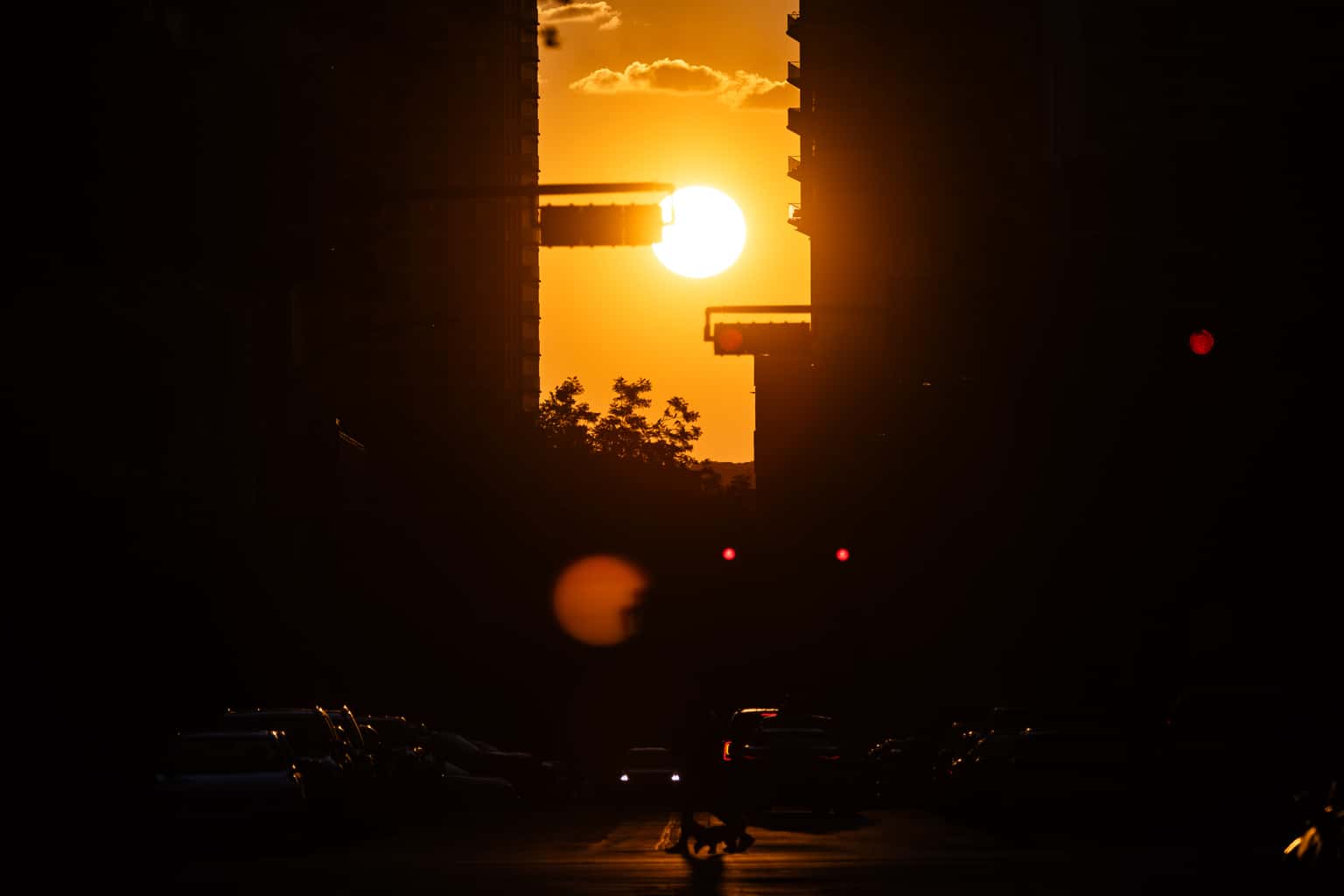
If you've spent any time downtown around sunset in early August, you've probably seen it: the sun drops low enough to slide right down the middle of an east-west street, turning the buildings on either side into a canyon and the road ahead into a tunnel of light. Around here, that's known as Austinhenge, and this weekend is right in the middle of it.
Every week we pick 🏆 the 5 best 🏆 things to do in Austin and send them to your inbox. Just one weekly email, no spam.
By submitting your email, you accept our Privacy Policy
The name is a nod to Stonehenge, which aligns with the sun at the summer and winter solstices, and Austin is in good company. Manhattan has Manhattanhenge, San Francisco has California Henge, and Chicago has Chicagohenge. The basic idea is the same everywhere: once or twice a year, the sun sets at just the right angle to line up perfectly with a city's street grid, and for a few minutes, the buildings frame the sun instead of blocking it.
In 2026, the two windows are in early August and early May. For downtown Austin, the sun lines up with the east-west streets on Thursday, Fourth Street. While Sunday is the day when the downtown streets are most perfectly aligned, the effect is virtually identical from Saturday through Monday, so you have a few evenings to catch it. One quirk worth knowing is why it doesn't happen during the spring and fall equinoxes: downtown's east-west streets actually tilt slightly northwest to southeast, so the sun never quite hits them head-on during those seasons.
Because different neighborhoods have grids laid out at slightly different angles, the alignment doesn't hit everywhere at once. The numbered streets just east of downtown align best around August 7, and some streets just south of the University of Texas campus hit their most perfect alignment on August 8. If you're not downtown, your best bet is to look at the streets in your own neighborhood and see if any of them run roughly east to west.
For anyone who wants to know the science behind it, Will Best, an astronomy researcher and lecturer at the University of Texas at Austin, explains that Austinhenge occurs an equal number of days before and after the summer solstice. The effect comes simply from the sun's position shining directly down the length of the street, which only happens when the sun's setting azimuth matches the street's bearing.
If you want to find the exact minute your own street lines up, there are tools for that. Hengefinder is one of the more precise, using astronomical calculations and real road data to predict alignments down to the minute, and it covers sunrise, sunset, moonrise, and moonset. It even has a 'Sauron Henge' mode for when the sun or moon appears directly on top of a building. The web version is at hengefinder.rcdis.co, and there's a mobile app at hengefinder.com.
Between now and Monday, the window is wide open. Grab a spot on one of those east-west streets, face west, and wait for the sun to drop into the gap. It's one of those things that's easy to miss if you aren't looking for it, but once you see the light tunnel, it's hard to forget.
Published Date
9 August 2026
More information